

Business Law Newsletter
BOI Reporting Is Dead: What FinCEN's NewRule Means for Your Business
LEGAL UPDATE
REGULATORY UPDATE
BOI Reporting Is Dead: What FinCEN's New
Rule Means for Your Business
August 2026 | A Legal Update from The Business Lawyers
After nearly two years of on-again, off-again enforcement, the federal beneficial ownership
reporting requirement is gone. Here's what actually changed, and what's still worth doing.
What Happened
On August 11, 2026, the Treasury Department's Financial Crimes Enforcement Network (FinCEN)
issued a final rule permanently removing the requirement for U.S. companies and U.S. persons to report
beneficial ownership information (BOI) under the Corporate Transparency Act (CTA). The rule took
effect August 14, 2026. FinCEN also announced it will delete previously reported information for U.S.
persons from its database.
This caps a long back-and-forth: the CTA's reporting requirement took effect in 2024, was challenged in
court, reinstated, narrowed by an interim rule in March 2025 that exempted domestic companies, and is
now permanently off the books for U.S. companies and U.S. persons.
What This Means for You
● If your company is formed in the U.S. and owned by U.S. persons, you no longer need to file or
maintain a BOI report with FinCEN.
● If you already filed a BOI report, you don't need to do anything further — FinCEN is removing that data
from its systems.
● The CTA itself remains on the books; this is a regulatory rule change, not a repeal by Congress. A
future administration or court ruling could theoretically revisit it, though that's not expected in the near
term.
The Exception: Foreign-Owned Entities and New York
The exemption applies to U.S. companies and U.S. persons. Entities formed outside the U.S. that
register to do business in a U.S. state still fall under the CTA's reporting requirements as “foreign reporting companies.”
Separately, New York's LLC Transparency Act — a state-level law modeled on the CTA — took effect
January 1, 2026. After a gubernatorial veto narrowed its scope, it now applies only to foreign LLCs (i.e.,
LLCs formed outside New York) that are authorized to do business in New York State. If you have an
LLC formed elsewhere and registered to do business in New York, this state filing obligation is separate
from the CTA and still applies.
Why this is still worth a conversation
Rules in this area have changed direction multiple times over the past two years. Keeping your
ownership and formation records current — regardless of what's required to be filed with a regulator
— remains good practice, and puts you in a strong position if the requirement changes again.
Questions About How This Affects Your Business?
Whether you have a foreign-owned entity, an LLC registered in New York, or just want to confirm
your filing obligations, The Business Lawyers can help you sort out what applies to your specific
situation. Reach out to talk it through.
This document is provided by The Business Lawyers for general informational purposes only. It does not constitute legal advice and does not create an
attorney-client relationship between you and The Business Lawyers or any of its attorneys. Laws vary by state and change over time; you should consult a
licensed attorney regarding your specific circumstances before acting or relying on this information.
AML/CFT Program Effectiveness
AML compliance has always required policies and procedures. The more important question for 2026 is whether those policies and procedures show that the program is actually designed around the firm’s real risk profile.
For many financial services firms, the weak point is not the absence of an AML program. It is the use of a generic program that was never fully adapted to the firm’s current clients, transactions, service lines, geography, or staffing model.
FinCEN’s proposed AML/CFT reform emphasizes risk-based and reasonably designed programs, with attention focused on higher-risk activities rather than purely formal completeness (FinCEN AML/CFT proposed reform). SEC examination priorities also continue to focus on AML programs tailored to the firm’s business model and risk profile (Harvard Law summary of 2026 SEC exam priorities).
That creates a practical documentation question for business owners: could someone outside the firm understand why your AML program is designed the way it is?
Here is what owners and executives should review:
The risk assessment. Does it describe your actual client base, transaction patterns, jurisdictions, products, and services?
The control map. Does every high-risk area have a corresponding control, named owner, review frequency, and documented output?
The escalation process. Does the team know when an issue becomes a suspicious activity concern and who decides what happens next?
Independent testing. Does the testing evaluate whether the program works, or does it simply confirm that documents exist?
Record retrieval. Can the firm quickly produce the risk assessment, control evidence, testing results, training records, and program updates?
From The Business Lawyers' perspective, the legal issue is defensibility. A template program may look complete, but if it cannot show why the firm’s actual risks were identified and how the controls address those risks, it may be difficult to defend in an examination or dispute.
From The Business Advisors' perspective, effectiveness depends on operating discipline. Controls need owners. Reviews need calendars. Findings need follow-up. Documents need to be stored where they can be retrieved by someone other than the person who created them.
The shift is simple but important: AML compliance should not only document effort. It should document judgment.
If your AML program has not been refreshed since your client base, transaction activity, or service offerings changed, it may be time for a targeted review.
If you would like to assess whether your AML documentation supports the way your firm actually operates, reply with “AML Review” or schedule a consultation with The Business Lawyers.
This newsletter is for educational purposes only and does not constitute legal, tax, accounting, investment, or compliance advice. For advice about your specific circumstances, consult qualified counsel or the appropriate professional advisor.
AI Governance for Finance and Accounting Workflows
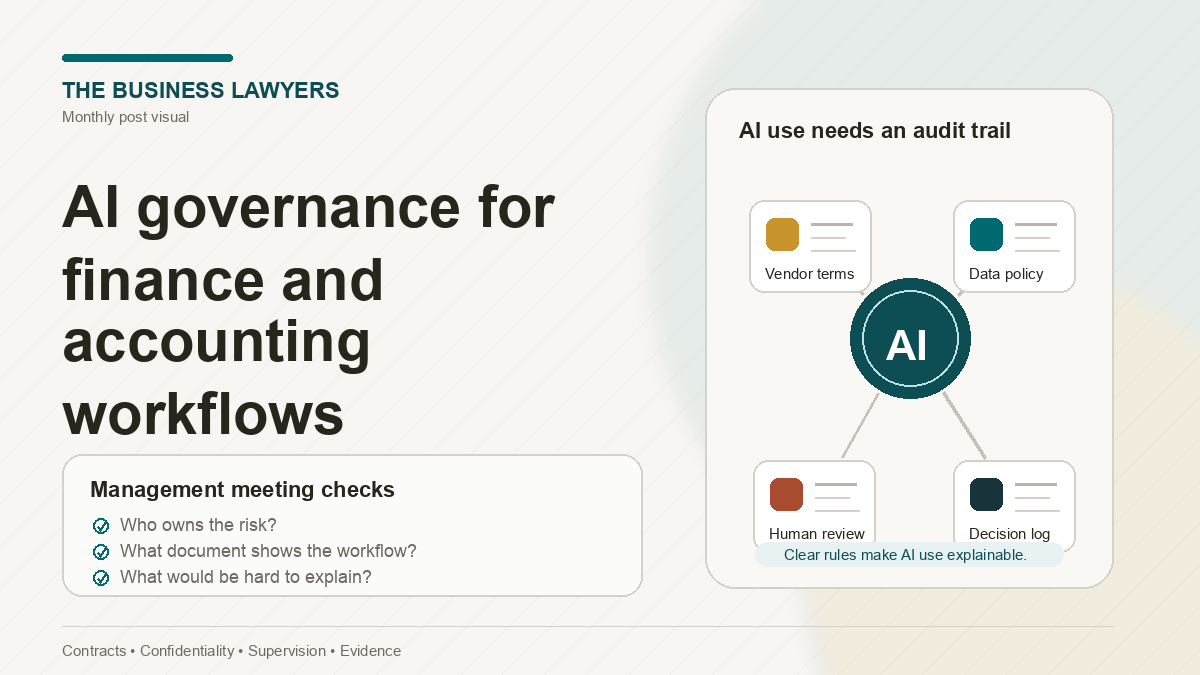
AI can speed up finance work, but it also creates contract, confidentiality, supervision, and evidence problems if the business has no rules for use.
For owners in financial services and accounting, the practical question is not only whether the business is keeping up with the trend. The better question is whether the business can prove how it makes decisions, protects information, manages vendors, and supervises the people and systems doing the work.
Three questions to bring to the next management meeting:
· Who owns this risk inside the business?
· What policy, contract, checklist, or report shows how the business handles it?
· What would be difficult to explain if a client, regulator, carrier, bank, or buyer asked about it?
The businesses that handle this well usually do not have the longest policies. They have clear responsibility, practical workflows, and records that show decisions were made deliberately.
Deloitte reported that finance departments are moving from AI experimentation toward measurable impact, with governance, cybersecurity, and workflow integration becoming central finance leadership issues. Capterra's 2026 accounting survey found that 53% of accounting professionals use AI in accounting software or key work tools and that oversight remains important because mistakes still occur in high-risk financial tasks.
If your firm is updating contracts, vendor terms, data policies, or operating procedures, The Business Lawyers can help translate the business process into documents that actually match how the work gets done.
Welcome to The Business Lawyers
It all begins with an idea.
At The Business Lawyers, we believe growing your business shouldn’t mean navigating a legal minefield. Whether you are a professional services firm expanding to new markets l or an entrepreneur scaling your startup, our team is here to provide clear, practical legal solutions that protect and empower your vision.
Who We Are
We’re a dedicated team of legal experts specializing in corporate law, helping businesses like yours thrive. From crafting airtight contracts to ensuring compliance across state lines, we focus on strategies that let you grow with confidence—without the legal headaches.
What We Do
Protect Your Growth: Structure partnerships, contracts, and compliance plans to safeguard your business.
Simplify Expansion: Guide you through multi-state operations, like registering as a foreign entity in Arizona or navigating Florida’s regulations.
Mitigate Risks: Avoid pitfalls like misclassifying workers or neglecting intellectual property protection.
Why Choose Us?
Our approach is straightforward: we listen, strategize, and deliver tailored solutions that align with your goals. Think of us as your legal co-pilot, ensuring smooth sailing whether you’re launching a new service line or protecting your brand.
Get to Know Us
This summer, we are excited to launch our newsletter series, sharing insights on corporate law trends to keep your business ahead of the curve. Subscribe to stay informed, and let’s connect to discuss how we can support your growth!
Ready to grow smarter? Contact us today at www.TheBusinessLawyers.Us for a complimentary consultation, or reply to this newsletter to share your biggest business challenge.